
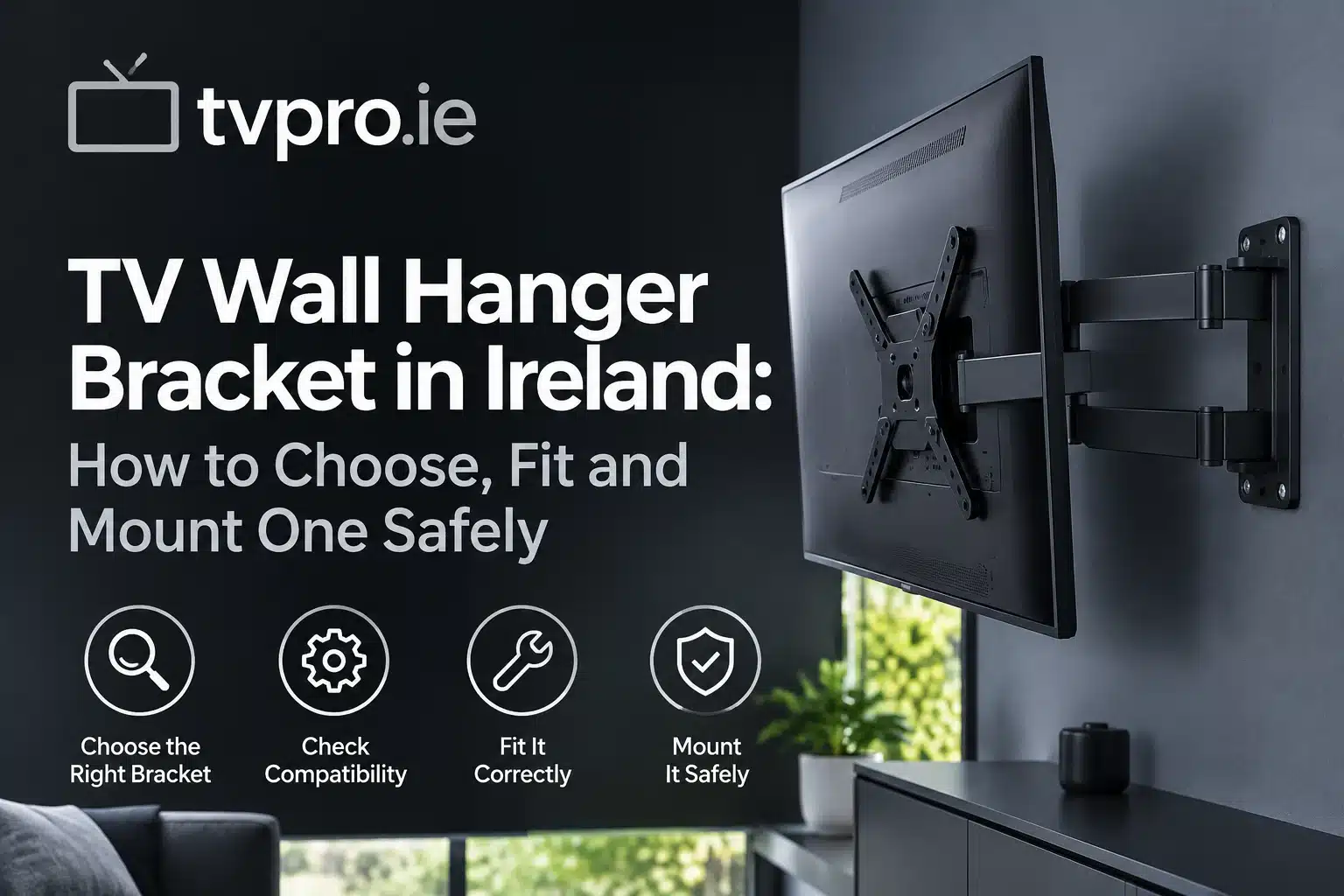
A TV wall hanger bracket is the metal mount that holds your television on the wall, and picking the right one matters more than most people expect. The correct bracket keeps your screen secure, sits at a comfortable viewing angle and leaves your room looking clean. The wrong one can sag, block your ports, or put a very expensive screen at risk.
This guide explains the main types of TV wall hanger brackets, how to match one to your TV, what to check on Irish wall types, and when it makes sense to call a professional. If you would rather skip the research, the team at TVPro fits brackets and mounts TVs across Dublin, Leinster and beyond.
Quick answer: To choose a TV wall hanger bracket, match three things: the VESA hole pattern on the back of your TV, the TV’s weight against the bracket’s rated load, and the type of wall you are fixing to. Then choose fixed, tilt or full motion based on how you watch.
What Is a TV Wall Hanger Bracket?
A TV wall hanger bracket (also called a TV wall mount, TV wall bracket, TV hanger or TV mounting bracket) has two main parts. A wall plate is fixed to the wall, and arms or rails attach to the back of the TV. The TV is then hooked or slid onto the wall plate and locked in place.
People search for it under different names, but they all describe the same job: getting a TV off a stand and onto the wall safely. Wall mounting frees up floor and furniture space, raises the screen to a better height, and makes it easier to hide cables. For a wider look at the whole process, see our complete guide to TV wall mounting in Ireland.
Types of TV Wall Hanger Brackets
There are three everyday styles, plus a few specialist ones. The best choice depends on the room, not on which is most expensive.
Fixed (Flat) TV Brackets
A fixed bracket holds the TV flat and close to the wall, usually a few centimetres away. It gives the neatest, slimmest finish and is the simplest and most affordable option. The trade-off is that you cannot adjust the angle, and access to the back of the TV is limited once it is up.
Fixed brackets suit bedrooms, living rooms where the TV is at eye level, and anywhere you want a clean look. Our article on why a fixed TV wall mount is worth choosing goes into more detail.
Tilting TV Brackets
A tilt bracket lets you angle the screen up or down by a few degrees. This reduces glare from windows and lights, and it helps when the TV has to sit higher than eye level, for example above a fireplace or a sideboard. It still sits fairly close to the wall.
Full Motion (Swivel and Tilt) TV Brackets
Full motion brackets, sometimes called articulating brackets, extend from the wall, swivel left and right, and tilt. They are ideal for open-plan rooms, corner positions, or spaces where you watch from the sofa and the kitchen table. Because the TV hangs further out, the wall fixings carry more leverage, so wall strength and correct installation matter even more. Read our guide to adjustable TV wall mounts if flexibility is your priority.
Corner, Ceiling and Specialist Mounts
Some rooms need something different. A corner TV wall mount makes use of awkward space, while a ceiling TV mount works where wall space is limited. Art-style televisions also need careful handling, which is why we offer dedicated Samsung Frame TV installation.
Fixed vs Tilt vs Full Motion – Quick Comparison
| Bracket type | Best for | Main benefit | Main limitation |
| Fixed | Eye-level viewing, bedrooms, slim look | Closest to the wall, lowest cost | No angle adjustment |
| Tilt | TVs mounted high, rooms with glare | Reduces reflections, easier viewing angle | Limited movement |
| Full motion | Open-plan rooms, corners, multiple seats | Swivels, extends and tilts | Sits further from wall, needs strong fixing |
How to Choose the Right TV Wall Hanger Bracket
1. Check the VESA Pattern
VESA is the standard spacing of the four mounting holes on the back of your TV, measured in millimetres, for example 200 x 200 or 400 x 400. The bracket must support your TV’s VESA pattern. The number is in your TV manual or on the manufacturer’s website, and you can also measure the distance between holes yourself, horizontally and then vertically.
2. Match the Weight Rating
Every bracket has a maximum load. Choose one comfortably above your TV’s weight, not one that only just meets it. A generous margin matters most for full motion brackets, where the arm adds leverage.
3. Do Not Rely on Screen Size Alone
Brackets are often sold by screen size range, such as 32 to 55 inches. That is a useful starting guide, but VESA and weight are the figures that decide whether a bracket is actually safe for your TV.
4. Think About How You Watch
If you watch from one spot at eye level, a fixed bracket is plenty. If light reflects off the screen, choose tilt. If you watch from several positions, full motion makes sense. Our guide on choosing the right TV bracket for everyone walks through these decisions step by step.
5. Plan for Cables and Connections
Decide early where the power lead, aerial, HDMI and any soundbar cables will run. A bracket that leaves a gap behind the TV makes it easier to connect devices, and planning cable routes now avoids ugly wires later. See our tips on hiding TV cables without damaging your walls.
Which Wall Do You Have? Mounting on Common Irish Wall Types
The bracket is only as secure as the wall behind it. Irish homes vary a lot, so identify your wall before you buy fixings or hang anything.
Plasterboard on Studs (Dry-Lined and Stud Walls)
Many Irish homes, especially apartments and newer builds, use plasterboard over timber or metal studs. Plasterboard alone cannot carry a TV, so the bracket needs to be fixed into the studs behind it, or use fixings specifically designed and rated for the load. Locating studs accurately is the key step. Our article on what to expect when chasing wires into plasterboard explains how a clean finish is achieved.
Solid Concrete and Brick
Solid walls give excellent holding power when drilled with the right masonry bit and fixed with proper wall plugs and bolts. They are the easiest surface to mount on, but you need to check for pipes and cables before drilling.
Hollow Concrete Block
Hollow blocks are common in Irish construction. Standard plugs can fail if they expand into an empty cavity, so fixings designed for hollow block are needed.
Chimney Breasts and Timber Frame
Mounting above a fireplace is popular, but check for heat, flue position and wall construction first. Timber frame houses need fixings into the timber members rather than only the lining. When you are unsure, a quick wall check by a professional is cheap insurance.
What Is the Best Height for a Wall-Mounted TV?
A good rule is to place the centre of the screen at about eye level when you are seated. For many living rooms that falls roughly in the region of 100 to 120 cm from the floor to the middle of the screen, though sofa height and seating distance change this. In bedrooms where you watch lying down, the TV usually goes a little higher. If it must go higher, such as above a fireplace, a tilting bracket helps compensate. Before drilling, hold the TV up or mark its outline with painter’s tape and sit in your usual spot to test the view.
DIY or Professional Installation?
Mounting a TV yourself is possible with a drill, a spirit level and a stud detector, but small mistakes carry a high cost. Poorly placed fixings, the wrong plugs for the wall, or an overloaded bracket are common reasons TVs end up damaged. Read why DIY TV mounting goes wrong for real examples.
A professional installer checks the wall, picks fixings rated for the load, levels the TV precisely, and can conceal the cables inside the wall for a clean finish. If you want the result done right the first time, our TV installation services cover wall mounting, cable concealment and more. You can also learn why it pays to hire a professional for TV wall mounting.
Common Mistakes When Fitting a TV Wall Hanger Bracket
- Buying by screen size only and ignoring VESA and weight.
- Fixing into plasterboard without locating the studs or using rated fixings.
- Choosing a full motion arm for a lightweight or weak wall without checking the load.
- Mounting too high, which causes neck strain over time.
- Forgetting about cables until after the TV is on the wall.
- Leaving the bracket slightly off level, which you notice every time the TV is on.
TV Wall Hanger Bracket Installation Across Ireland
Whether you are in the city or the countryside, a local installer saves time and gives you someone to call if you need adjustments later. TVPro serves homes and businesses in many areas, including TV installation in Dublin, Sandyford, Tyrrelstown, Straffan, Dundalk, Westmeath, Wicklow Town and the Rush, Lusk and Skerries area. Check our full service area page to see if we cover you.
Moving into a new property? Our new home TV installation service helps you plan the TV wall, brackets and cabling from day one. If you are also improving your home entertainment setup, you can browse the TVPro shop for useful extras.
Why Choose TVPro for Your TV Wall Hanger Bracket
At TVPro, we help you choose the right bracket for your TV and your wall, then fit it securely and neatly. We assess the wall before drilling, level the TV precisely, and tidy the cables so the finished room looks as good as it works. You can see examples on our gallery and recent jobs pages, and read what customers say on our testimonials page.
Ready to get your TV on the wall? Contact TVPro for friendly advice and a quote.
Frequently Asked Questions About TV Wall Hanger Brackets
What is a TV wall hanger bracket?
A TV wall hanger bracket is a metal mount that attaches to the back of a television and to the wall, holding the TV securely off the floor or furniture. It is also called a TV wall mount or TV wall bracket.
Which type of TV wall bracket is best: fixed, tilt or full motion?
Fixed brackets are best for a slim, eye-level setup. Tilt brackets suit TVs mounted higher or in rooms with glare. Full motion brackets are best when you need to turn the screen to different seating areas.
How do I know if a bracket fits my TV?
Check that the bracket supports your TV’s VESA hole pattern and that its maximum weight rating is above your TV’s weight. Screen size ranges are only a guide.
What is VESA on a TV?
VESA is the standard spacing of the four mounting holes on the back of a TV, measured in millimetres, such as 200 x 200 or 400 x 400. It determines which brackets are compatible.
Can I mount a TV on a plasterboard wall in Ireland?
Yes, but the bracket should be fixed into the studs behind the plasterboard, or use fixings rated for the load. Plasterboard alone is not strong enough to support a TV.
How high should I mount my TV on the wall?
Place the centre of the screen roughly at eye level when seated. In many living rooms this is around 100 to 120 cm from the floor to the middle of the screen, but it varies with your seating.
Can any bracket hold any TV size?
No. Each bracket has a limit for weight and a supported VESA pattern. A bracket that suits a 43 inch TV may not be safe for a 75 inch model, so always check both.
Is it better to hire a professional to install a TV bracket?
A professional checks the wall type, uses suitable fixings, mounts the TV level and can hide the cables. This lowers the risk of damage and gives a cleaner finish than most DIY jobs.
Can a TV be mounted above a fireplace?
Often yes, but you need to check heat, the flue and the wall construction first. A tilting bracket usually helps with the higher viewing angle.
Does TVPro install TV wall brackets across Ireland?
TVPro installs TV wall brackets in Dublin and in many other areas, including Wicklow, Dundalk, Westmeath and north county Dublin. See our service area page or contact us to confirm coverage for your location.
Final Thoughts
The right TV wall hanger bracket comes down to three checks: VESA, weight and wall type. Add a sensible viewing height and a plan for your cables, and you will have a TV that is safe, comfortable to watch and neat on the wall. For a result you can trust, talk to TVPro about your TV wall mounting today.
continue reading