
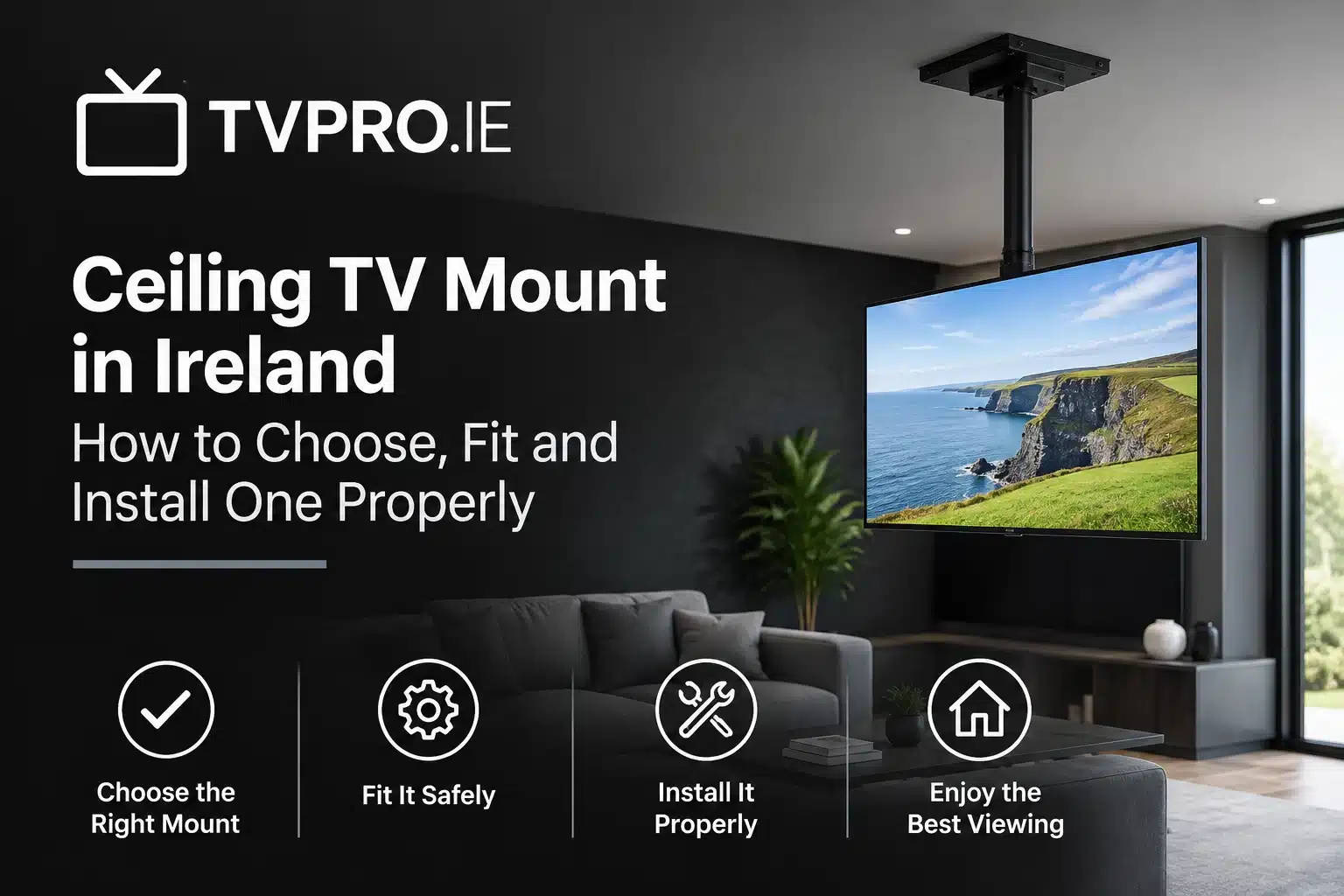
A ceiling TV mount suspends your television from the ceiling on a pole or drop-down arm, leaving the walls free. It suits bedrooms, open-plan spaces, attic conversions, garages and commercial spaces where a wall mount is awkward or impossible. In Irish homes the mount must be fixed into solid ceiling joists or structural concrete, never into plasterboard alone, and the bracket must be rated for your TV’s weight and VESA pattern.
That short answer covers the essentials, but the details matter. A ceiling-mounted TV hangs overhead, so a poor fixing, a wrong bracket or a badly judged viewing angle is far more noticeable (and far less forgiving) than on a wall. This guide explains how ceiling mounts work, which type fits which room, how to check what is above your ceiling, and when it is worth bringing in a professional.
What Is a Ceiling TV Mount?
A ceiling TV mount is a bracket system that attaches to the ceiling at the top and holds your television at the bottom. Between the two sits a pole, arm or telescopic extension that lets the screen hang at a comfortable height in the room.
Most ceiling mounts include a few common features:
- A ceiling plate that is screwed or bolted into the structure above.
- A drop pole or arm, either a fixed length or adjustable, that sets how far the TV hangs below the ceiling.
- A VESA head that connects to the mounting holes on the back of the TV.
- Tilt and swivel adjustment, so the screen can face the seating area rather than just staring straight ahead.
The idea is simple, but the engineering has to be right because the full weight of the TV, plus any knocks or vibration, is carried by a handful of fixings over your head.
When Does a Ceiling TV Mount Make Sense?
Wall mounting is still the most popular choice in Ireland, but there are plenty of situations where the ceiling is the smarter option.
In the Home
- Bedrooms: a TV angled down towards the bed keeps the walls clear of brackets and cables, which works well in small rooms.
- Open-plan kitchens and living areas: when there is no suitable wall, a ceiling mount lets you place the screen where people actually sit.
- Attic conversions and sloped ceilings: low walls and angled roofs rarely suit a standard bracket. A ceiling fixing, or a specialist sloped-ceiling adaptor, can solve it.
- Rooms with windows, radiators or glass walls: if the wall space is taken up, the ceiling may be the only clear surface left.
- Garages, home gyms and games rooms: a hanging screen can be angled towards the workout or play zone and kept out of the way of equipment.
In Businesses
Pubs, cafés, barbershops, salons, gyms, waiting rooms and retail units often use ceiling mounts so screens can be seen from several directions. Back-to-back dual brackets let two TVs face opposite ways from a single fixing, which is handy for commercial TV installations where customers are seated all around a room.
When a Wall Mount Is Better
It is worth being honest about this. A wall mount is usually the better choice if you have a suitable solid wall, want the TV at eye level, plan to mount a very large or heavy screen, or want the neatest possible finish. Slim art-style screens such as the Samsung Frame are designed to sit flush against a wall, so they are better suited to a Samsung Frame TV installation than to a ceiling pole.
Types of Ceiling TV Mounts
Not every ceiling bracket works the same way. Here is how the main types compare.
| Mount type | How it works | Best for |
| Fixed pole mount | Rigid pole at a set length, with a tilt head | Bedrooms, offices and rooms where the viewing position never changes |
| Adjustable drop (telescopic) mount | Pole length can be changed to raise or lower the TV | Rooms with different ceiling heights, or where you want fine control |
| Tilt and swivel ceiling mount | Adds sideways rotation and tilt to the pole | Open-plan rooms and spaces with viewing from more than one angle |
| Flip-down (fold-away) mount | TV folds up against the ceiling when not in use | Low-use TVs, small bedrooms and attics |
| Motorised ceiling mount | Remote-controlled drop and tilt | Premium installs and bedrooms where you want the screen hidden away |
| Dual back-to-back mount | Two screens on a single fixing, facing opposite directions | Pubs, shops, gyms and shared spaces |
| Sloped-ceiling adaptor | Wedge or angled plate that levels the mount on a pitched ceiling | Attic rooms and dormer ceilings |
How to Choose the Right Ceiling TV Mount
Before you buy anything, work through this checklist. It takes a few minutes and prevents most of the expensive mistakes.
1. Check Your TV’s Size and Weight
Every mount has a maximum screen size and a maximum load. The weight limit is the figure that really counts. Look up your TV’s weight without the stand, and choose a mount comfortably above it, because the weight of a swinging or tilted screen puts extra stress on the fixings.
2. Confirm the VESA Pattern
VESA is the standard hole pattern on the back of most TVs, measured in millimetres (for example 200 x 200 or 400 x 400). The mount’s head must support your TV’s pattern. Some curved, ultra-thin or older TVs have unusual mounting points, so check the manual before ordering.
3. Measure the Drop You Need
The “drop” is the distance from the ceiling to the centre of the TV. In a standard Irish room with a ceiling around 2.4 metres, a short pole may leave the screen far too high, while a long pole in a low attic can leave it dangling in the way. Measure from the ceiling to your ideal screen height and compare it with the mount’s adjustment range.
4. Think About Tilt and Swivel
A ceiling TV sits above eye level, so it almost always needs to tilt downwards. If people watch from two or three spots, such as a sofa and a dining table, swivel adjustment becomes just as important.
5. Know Your Ceiling Type
This is the most important step and gets its own section below.
6. Plan for Power and Cables
A TV on a pole still needs power, an aerial or streaming feed, and often an HDMI or soundbar connection. Decide early whether cables will run down the pole in a cover, be hidden in the ceiling void, or be routed along a wall. Planning this before the mount goes up is much easier than fixing it afterwards.
Know Your Ceiling before You Drill
A ceiling mount is only as safe as the structure it is fixed to. In Ireland, ceilings come in several forms, and each needs a different approach.
Timber Joist Ceilings
Many houses, particularly older and traditionally built homes, have plasterboard or plaster ceilings fixed to timber joists. These are commonly spaced at roughly 400mm to 600mm apart. The mount’s ceiling plate should be screwed into the joists, ideally spanning two of them, using fixings suited to the load. Locating the joists accurately is essential, and so is checking for pipes and electrical cables before any drilling.
Concrete Ceilings
Apartments and some newer or commercial buildings use concrete floor slabs as ceilings. Concrete can provide a very strong fixing, but it needs the correct masonry anchors and drill bits. In some apartment buildings and post-tensioned slabs, drilling in the wrong place can cause serious damage, so check with your management company or landlord first.
Plasterboard Only
If there is no joist or solid structure behind the plasterboard, it will not safely hold a TV on its own. In that case you need reinforcement above the ceiling, such as timber noggins fitted between joists, or a different mounting solution altogether.
Suspended and Fire-Rated Ceilings
Suspended ceiling tiles are not designed to carry a TV. Some apartments, offices and multi-storey buildings also have fire-rated ceiling systems, and penetrating them without the right approach can compromise their rating. If you are unsure, get the building inspected first.
Attics and Roof Spaces
If there is an attic above, access matters. Insulation, wiring and water tanks all affect how and where a mount can be fixed. A professional can often work out whether reinforcement is practical before any drilling starts.
Getting the Height and Viewing Angle Right
A ceiling-mounted TV can look great or be a constant neck ache. Aim for the centre of the screen to sit as close to seated eye level as the room allows, then tilt the screen down slightly so you are looking at it face-on rather than from below.
Two things to consider:
- Seating position: sit where you will usually watch and have someone hold the TV, or a cardboard cut-out, at the proposed height. If you have to tilt your head back, the drop is too short.
- Glare: ceilings often sit near windows or lights. Check how daylight and lamps reflect on the screen at different times of day, since a downward tilt can catch reflections you did not expect.
Ceiling TV Mount Installation: What’s Involved
The process is more involved than a standard wall mount, which is why many people prefer a professional. In outline, it looks like this:
- Survey the ceiling: identify joists or concrete, and check for hidden services.
- Plan the position: confirm drop, viewing angle, power and cable route.
- Fix the ceiling plate into the structure with suitable anchors or screws.
- Attach the VESA brackets to the back of the TV.
- Lift and secure the TV to the pole or arm. This is a two-person job at minimum, often with a lift aid for larger screens.
- Adjust tilt and swivel, tighten all locking points and test for movement.
- Tidy and conceal cables, then check everything works.
DIY or Professional Installation?
A small, light TV on a fixed pole in a timber-joist ceiling is within reach of a confident DIYer, though lifting a screen overhead is awkward and risky alone. Professional installation is the better call when the screen is large or heavy, the ceiling is concrete or unknown, cables need hiding, the room is in a rented or managed property, or the TV is in a public space where a fall would be a liability issue.
Common Ceiling TV Mount Mistakes to Avoid
- Fixing into plasterboard alone: the single most dangerous mistake.
- Choosing a mount by screen size only: weight and VESA matter just as much.
- Ignoring the drop: a screen hung too high or too low ruins the experience.
- Not planning cables: loose wires dangling from a ceiling pole look untidy and can be a hazard.
- Skipping the safety check: mounts should be tightened, tested and re-checked from time to time, as locking points can work loose.
- Buying the cheapest bracket for a big TV: low-quality brackets may not meet the stated load rating in practice.
Ceiling Mounts and New Builds
If you are moving into a new home or having work done, the best time to plan a ceiling mount is before the plasterboard goes up. Timber reinforcement and a concealed cable route can be added in minutes at that stage. TVPro’s new home TV installation service is designed around this kind of forward planning, including cable routing and positioning.
Professional Ceiling and Special TV Installations in Ireland
At TVPro, we install TVs across Dublin, Meath, Kildare and Wicklow, on brick, concrete and plasterboard alike. Our TV installation service covers the standard wall-mounted jobs, while our special installations cover setups that go beyond a standard wall bracket, which is where unusual mounting positions and awkward rooms usually fall. If you are considering a ceiling mount, contact us with your room details and TV size and we will confirm the best approach.
We work in homes, and also in nursing homes, hotels, offices and retail spaces through our commercial installation service.
Areas We Cover
If you are searching for a TV installer near you, these are some of the areas we serve:
- TV installation in Dublin, including the city and surrounding suburbs
- TV installation in Sandyford and south Dublin
- TV installation in Tyrrelstown and the Dublin 15 area
- TV installation in Rush, Lusk and Skerries in north County Dublin
- TV installation in Straffan and north Kildare
- TV installation in Dundalk and County Louth
- TV installation in Wicklow Town and the Wicklow area
- TV installation in Westmeath
You can also view our full service area page, browse our gallery of completed installations, or get in touch directly for a quote.
Frequently Asked Questions About Ceiling TV Mounts
What is a ceiling TV mount?
A ceiling TV mount is a bracket that attaches to the ceiling and holds a television on a pole or arm, so the TV hangs below the ceiling instead of sitting on a stand or wall. Most models allow height adjustment, tilt and swivel.
Can you mount a TV on the ceiling?
Yes, provided the mount is fixed into solid ceiling joists or structural concrete and is rated for the TV’s weight. A ceiling mount should never be fixed into plasterboard alone.
Is a ceiling TV mount safe?
A ceiling TV mount is safe when the mount is rated for the screen, correctly fixed into a strong structure, and installed with all locking points tightened. Safety depends on the ceiling as much as the bracket, so a survey before installation is strongly recommended.
Can a ceiling TV mount hold a heavy TV?
It can, if both the mount and the ceiling are rated for the load. Check the maximum weight on the mount, choose one with comfortable headroom above your TV’s weight, and make sure the ceiling structure can carry it. Larger TVs often need reinforced fixings.
Where should a ceiling TV be positioned?
Place it so the centre of the screen is close to seated eye level and tilt it slightly downwards towards the seating area. Test the position with a helper before drilling.
What size TV suits a ceiling mount?
Most ceiling mounts handle screens from roughly 32 to 70 inches, though ranges vary by model. Always check the stated size, weight and VESA limits, as weight matters more than inches.
Can I fit a ceiling TV mount in an apartment or rented home?
Possibly, but get permission first. Apartment ceilings are often concrete or fire-rated, and landlords or management companies may restrict drilling. A professional installer can advise on what is permitted.
Can you put a ceiling TV mount on a sloped or attic ceiling?
Yes. A sloped ceiling adaptor or angled plate levels the mount on a pitched surface, but the fixing still needs to reach solid roof or ceiling framing. Attic rooms usually need a site check first.
Do I need a professional to install a ceiling TV mount?
A professional is recommended for large TVs, concrete ceilings, unknown ceiling construction, hidden cabling or commercial spaces. Smaller TVs on simple timber ceilings can be a DIY job, but lifting the TV overhead safely needs at least two people.
Can the cables be hidden with a ceiling mount?
Yes. Cables can run through a cover on the pole, be concealed in the ceiling void, or be routed neatly along a wall. Planning cable routes before installation gives the cleanest result.
How do I get a ceiling TV mount installed in Dublin, Meath, Kildare or Wicklow?
Contact TVPro with your TV size, room type and ceiling construction. We will advise on the best mounting option and arrange a booking, wherever you are in our service area.
Final Thoughts
A ceiling TV mount can be the neatest answer to a tricky room, but only when the bracket, the ceiling and the viewing position are all right. Start with your ceiling type, match the mount to your TV’s weight and VESA pattern, plan your cables, and do not compromise on the fixing. If you are in any doubt, a professional survey costs far less than repairing a fallen TV.
Ready to get it done properly? Visit TVPro or contact our team to talk through your ceiling TV mount installation anywhere in Dublin, Meath, Kildare and Wicklow.
continue reading